


SPERM AREN´T ALONE ON THEIR JOURNEY TO FERTILISATION. TINY VESICLES HELP THEM MATURE
27. 07. 2026
Czech scientists have, for the first time, comprehensively characterised tiny membrane vesicles released from different regions of the porcine epididymis and demonstrated that they bind to sperm and deliver molecules essential for their maturation. The findings, published in the Journal of Extracellular Vesicles, provide new insights into sperm biology and may contribute to the future development of assisted reproduction methods and the diagnosis of male infertility.
A research team from the Institute of Biotechnology of the Czech Academy of Sciences, the Faculty of Science of Charles University, and the Czech University of Life Sciences Prague used mass spectrometry, electron microscopy, and confocal microscopy to characterise the composition of extracellular vesicles and directly observe their interaction with sperm. For the first time, the scientists compared vesicles from all three regions of the porcine epididymis as well as from seminal plasma and identified thousands of proteins whose composition reflects the different stages of sperm maturation.
The study also demonstrated that extracellular vesicles directly fuse with sperm and transfer their molecular cargo. In addition, the experiments showed that removing surface proteins prevents the vesicles from binding to sperm.
“Our results show that sperm are not merely passive carriers of genetic information. They actively communicate with their environment and, during maturation, acquire molecules from epididymal cells that are essential for their proper function. A better understanding of this process may, in the future, contribute to the development of new assisted reproduction methods and improved diagnostics of male infertility,” says Pavla Postlerová, principal investigator of the project at the Institute of Biotechnology of the Czech Academy of Sciences.
The authors also introduced a novel method for isolating extracellular vesicles while preserving their biological activity. These findings provide an important foundation for further research in reproductive biology, the development of new approaches to in vitro fertilisation, and assisted reproduction in livestock. As pigs are an important biomedical model with reproductive physiology similar to that of humans, the results may also contribute to a better understanding of human reproduction and support future clinical applications.
The study was supported, among others, by the ART – The Future of Assisted Reproduction programme of the Czech Academy of Sciences' Strategy AV21. This actuality is based on a press release issued by the Institute of Biotechnology of the Czech Academy of Sciences.
Online publication: https://isevjournals.onlinelibrary.wiley.com/doi/10.1002/jev2.70329
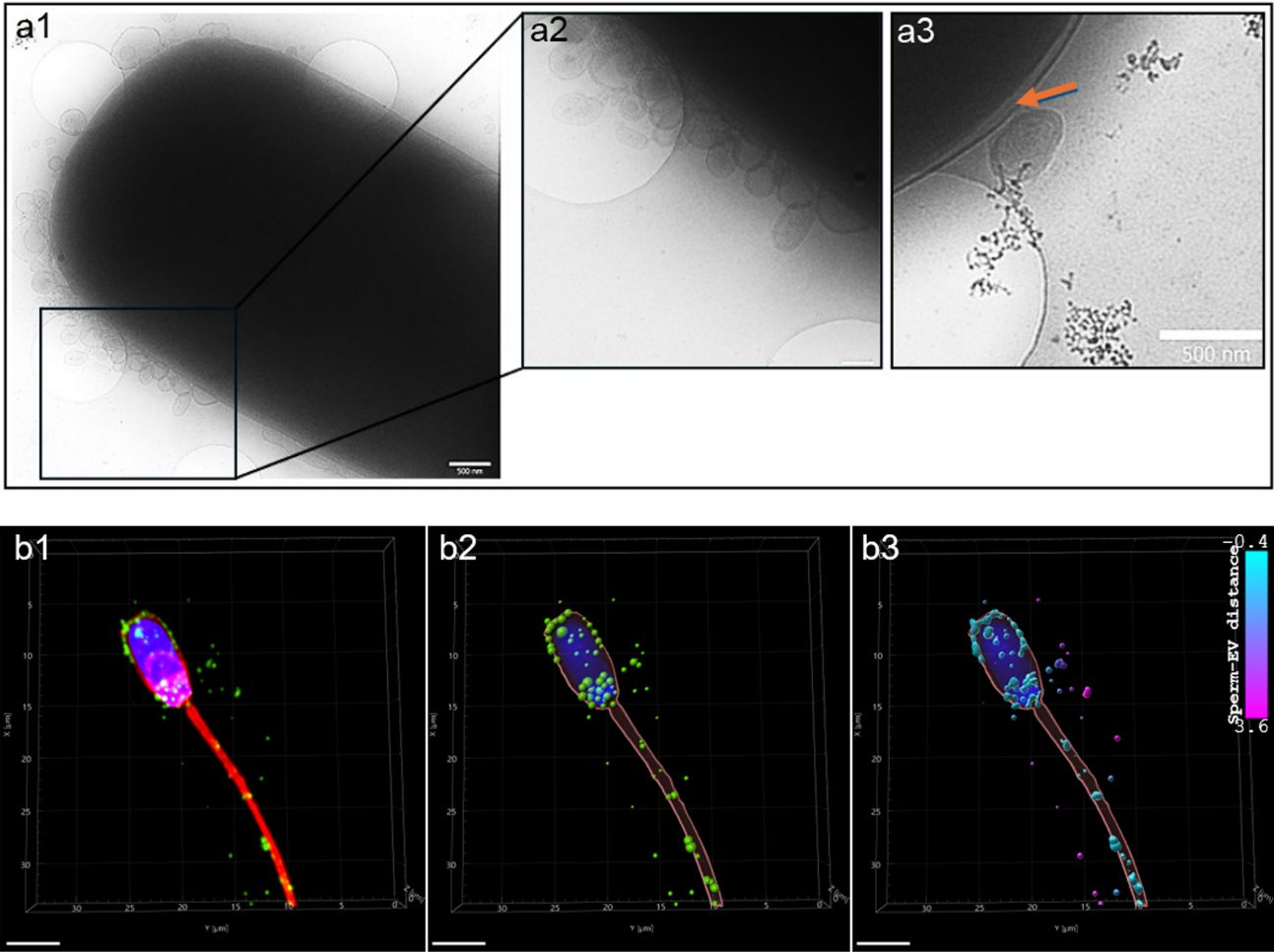
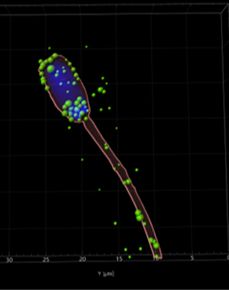
Visualization of extracellular vesicle binding and fusion with sperm using advanced microscopy techniques and three-dimensional (3D) imaging
(Source: Institute of Biotechnology of the Czech Academy of Sciences)
Read also
- CAN AN INTERSPECIES EMBRYO HELP SAVE ENDANGERED SPECIES?
- ART at the Science Fair once again
- FROM OOCYTE TO EMBRYO: STUDENTS GAINED HANDS-ON EXPERIENCE WITH MODERN REPRODUCTIVE BIOLOGY TECHNIQUES
- ART INVITES YOU TO THE III OOCYTE DAY – REGISTRATION IS NOW OPEN
- GUEST LECTURE: THE IMPACT OF GENETIC CHEATING ON MAMMALIAN REPRODUCTION AND SPECIATION
- GUEST LECTURE: THE IMPACT OF GENETIC CHEATING ON MAMMALIAN REPRODUCTION AND SPECIATION
- GUEST LECTURE: GENOME ORGANIZATION AND FUNCTION AROUND THE NUCLEOLUS DURING EARLY EMBRYO DEVELOPMENT
- PhD POSITION: HOW RNA CONTROLS EARLY LIFE
- ART Bridges Law and Medicine: Workshop on Assisted Reproduction in the Case Law of the European Court of Human Rights
- XXVIII Biological Days 2025 Highlighted Current Topics in Reproductive Biology and Oncology