


ART INVITES YOU TO THE III OOCYTE DAY – REGISTRATION IS NOW OPEN
10. 07. 2026
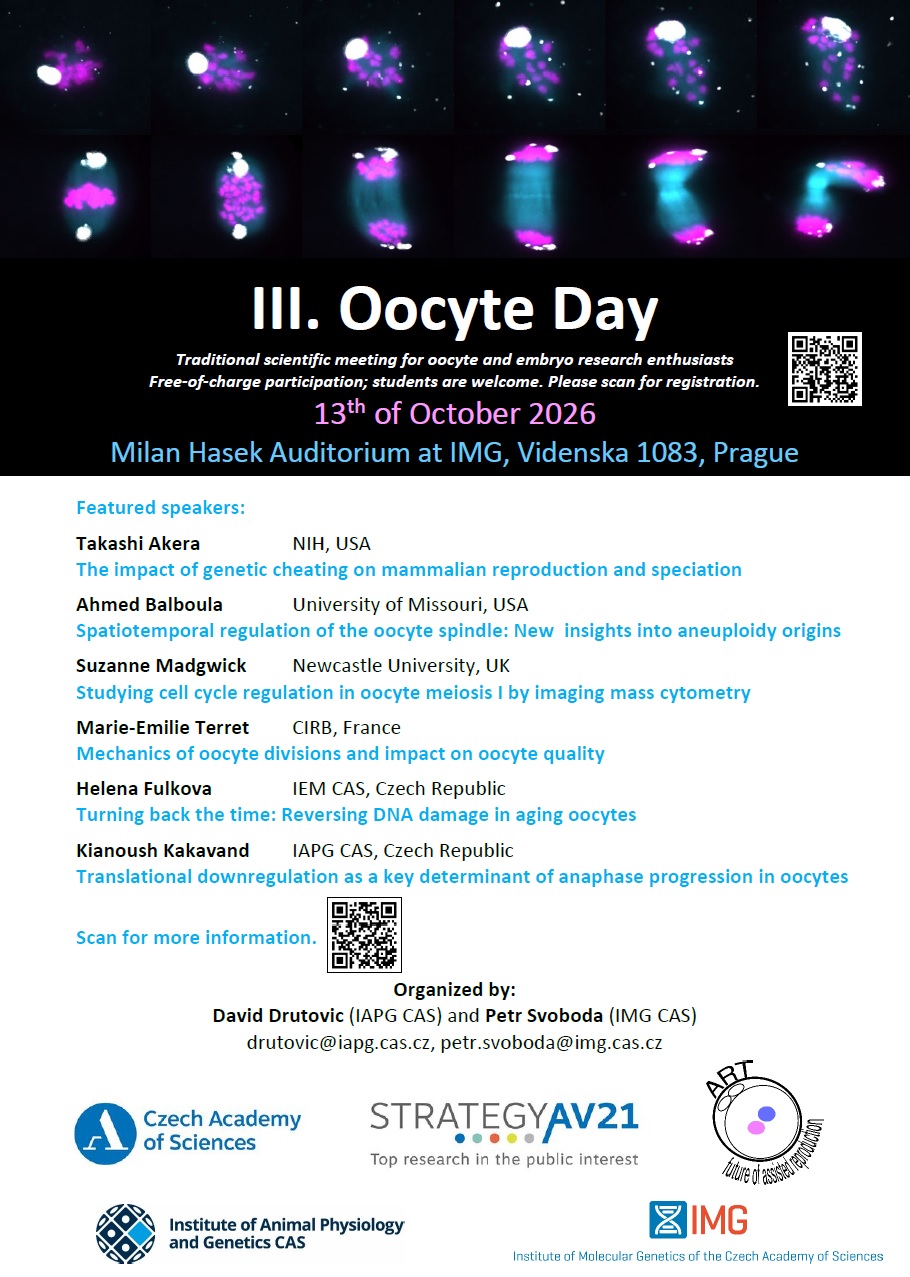
As part of the ART – Future of Assisted Reproduction project, the III Oocyte Day international conference will take place on 13 October 2026. The conference is organized by Dávid Drutovič from the Institute of Animal Physiology and Genetics of the Czech Academy of Sciences, in collaboration with the Institute of Molecular Genetics of the CAS.
The programme will feature lectures by leading experts from renowned Czech and international institutions, presenting the latest advances in mammalian oocyte and early embryo development, cell cycle regulation, genome stability, and advanced imaging technologies. The conference will also provide an opportunity for early-career researchers to present their work and discuss current trends in reproductive biology research.
Participation is free of charge, but registration is required. To register, please scan the QR code provided on the conference flyer.
For more information about the programme and conference organization, please visit the conference website: https://art.avcr.cz/en/oocyte-day/.
Read also
- IVF FOR WOMEN WITHOUT A PARTNER: LEGAL, ETHICAL AND MEDICAL CONSIDERATIONS
- III· OOCYTE DAY BROUGHT TOGETHER LEADING EXPERTS IN HUMAN AND OTHER MAMMALIAN OOCYTE RESEARCH
- 31ST SYMPOSIUM ON BIOLOGY AND IMMUNOLOGY OF REPRODUCTION (SBIR) AND 19TH ANNUAL MEETING OF THE EUROPEAN SOCIETY FOR REPRODUCTIVE IMMUNOLOGY (ESRI)
- WHEN SCIENCE COMMUNICATES: THE FUTURE OF ART PROJECT AT RESEARCHERS' NIGHT 2026
- WHAT DETERMINES THE FATE OF AN EMBRYO? JITKA TROJANOVÁ JOINS THE ART RESEARCH TEAM
- ART RETURNS TO THE SCIENCE IN ACTION SUMMER CAMP: A DAY EXPLORING THE FIRST MOMENTS OF LIFE
- ASSISTED REPRODUCTION IS MORE THAN JUST A MEDICAL ISSUE: KATEŘINA KOMRSKOVÁ CO-AUTHORS A NEW BOOK
- WHEN TEACHERS TAKE A SEAT IN THE CLASSROOM: ART AT THE SUMMER SCIENCE CAMP FOR TEACHERS
- THE MAGIC NUMBER 46, SPERM QUALITY AND THE FUTURE OF MALE FERTILITY: KATEŘINA KOMRSKOVÁ ON RADIOŽURNÁL
- SPERM AREN´T ALONE ON THEIR JOURNEY TO FERTILISATION. TINY VESICLES HELP THEM MATURE