


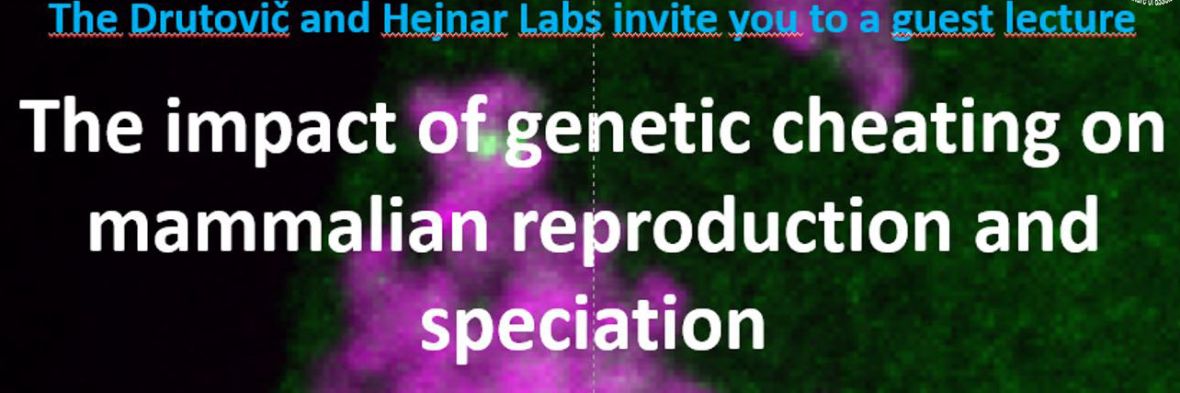
GUEST LECTURE: THE IMPACT OF GENETIC CHEATING ON MAMMALIAN REPRODUCTION AND SPECIATION
24. 03. 2026
The Drutovič Lab welcomes Dr. Takashi Akera (National Institute of Health, USA) for a guest lecture on genetic conflict and non-Mendelian inheritance. The talk will explore how selfish genetic elements “cheat” to bias their transmission and reveal new insights into how meiotic drive shapes mammalian reproduction and evolution.
ABSTRACT
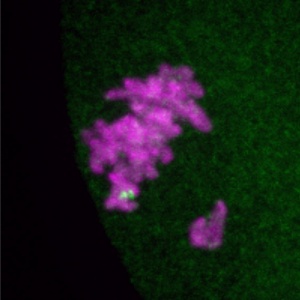 Mendel’s Law of Segregation states that each allele has an equal chance to transmit to the next generation. However, this law can be violated by selfish genetic elements, which manipulate the production of gametes (e.g., eggs, sperm, spores) to increase their own transmission rate. This genetic cheating in meiosis, meiotic drive, has significant impacts on Genetics, Evolution, and Reproduction because the cheating alters transmission ratios and manipulates gametogenesis, often leading to fertility issues and genetic disorders (e.g., Down Syndrome). In female meiosis, selfish elements bias their transmission by preferentially segregating to the egg. However, it remains largely unknown how these elements bias their segregation to the egg especially in mammals. My lab combines mouse genetics and cell biological approaches to capture cheating in action to reveal how these elements manipulate female gremline to preferentially segregate to the egg. I will discuss our recent findings on a previously unrecognized mechanism of meiotic drive in vertebrates and how it impacts mammalian reproduction and speciation.
ASPEAKER PROFILE
Dr. Takashi Akera studies how selfish gene elements violate the rules of inheritance and shape mammalian reproduction and speciation.
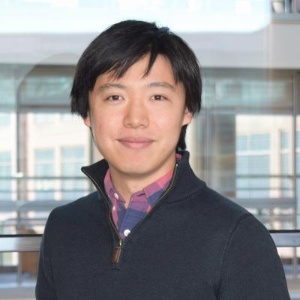 Dr. Takashi Akera is a molecular biologist whose research focuses on chromosome dynamics, evolution, and non-Mendelian inheritance. He investigates how selfish genetic elements violate Mendel’s law through meiotic drive and shape mammalian reproduction and speciation. He received his PhD in Biophysics and Biochemistry from the University of Tokyo in 2014 and completed his postdoctoral training at the University of Pennsylvania. His work has been recognized by several awards, including the Holtzer Award and the Kaushal Award for outstanding postdoctoral research (2018). In 2019, he joined the National Heart, Lung, and Blood Institute (NIH) as an Earl Stadtman Investigator. He has since received the NHLBI Outstanding Mentor Award (2024) and the Vilcek Prize for Creative Promise in Biomedical Sciences (2026). His laboratory combines mouse genetics, CRISPR/Cas9, high-resolution microscopy, and optogenetics to uncover the cellular and evolutionary mechanisms of meiotic drive and biased chromosome segregation.
Přečtěte si také
- GUEST LECTURE: GENOME ORGANIZATION AND FUNCTION AROUND THE NUCLEOLUS DURING EARLY EMBRYO DEVELOPMENT
- PhD POZICE: JAK RNA ŘÍDÍ RANÝ VÝVOJ ŽIVOTA
- ART propojuje právo a medicínu: workshop o asistované reprodukci v judikatuře Evropského soudu pro lidská práva
- XXVIII Biologické dny 2025 představily aktuální témata reprodukční biologie a onkologie
- Světové prvenství české vědy: stárnutí vajíček lze zvrátit
- Když život začíná v laboratoři: přednáška Martina Angera na Týdnu AV ČR
- Konference SBIR 2025 spojila světové odborníky na téma ART budoucnosti
- Od početí po zdravé stáří: ART budoucnosti u Biologických dnů 2025 – registrace prodloužena
- Nová diplomantka v projektu ART budoucnosti
- Věda v akci: studenti si vyzkoušeli asistovanou reprodukci i terénní výzkum