


GUEST LECTURE: GENOME ORGANIZATION AND FUNCTION AROUND THE NUCLEOLUS DURING EARLY EMBRYO DEVELOPMENT
17. 03. 2026
The Fulka Lab welcomes Dr Pritha Bhattacharjee (University of Zurich) for a guest lecture on genome organization in early embryos. The talk will present a new single-cell approach revealing how nucleolus–genome interactions shape 3D genome architecture after fertilization.
ABSTRACT
In mammalian development, genomes of two highly differentiated cells undergo massive epigenetic and spatial reconfiguration to form a zygote with the potential to generate a new organism. Increasing evidence indicates that the nucleolus (largest subnuclear compartment where ribosome biogenesis occurs), along with the nuclear lamina, plays an important role in the regulation of repressive chromatin regions. While genome re-organization at the lamina has been studied during early development, nucleolar associated domains (NADs) still remain under-investigated due to the difficulty in mapping chromatin domains contacting a membraneless organelle and limited sample availability.
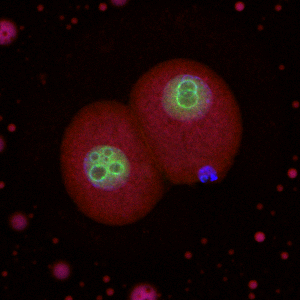
To this end, we developed single cell Nucleolar-DamID, a methodology to identify genomic regions interacting with nucleoli in oocytes, zygotes, 2-cell and 4-cell stages of embryo cleavage. We found that the nucleolus acts as a major hub for chromatin association in the absence of ribosome biogenesis and genome-lamina contacts (LADs). Mature oocytes, devoid of LADs, have broad NADs, enriched in H3K9me2 and depleted of K3K27me3. Furthermore, zygotes inherit NADs from oocytes and paternal NADs are established de novo upon fertilization. Further analyses to uncover the mechanism of NAD establishment and the functional role of nucleolar-genomic contacts in gene expression and development are ongoing.
SPEAKER PROFILE
Dr Pritha Bhattacharjee studies how the 3D genome is organized during the earliest stages of mammalian development.
 Dr Pritha Bhattacharjee is a molecular biologist whose research focuses on 3D genome organization and the development of genomic methods to study early mammalian development. She received her PhD from the Saha Institute of Nuclear Physics in Kolkata, where she investigated the structure of the nuclear lamina in the context of dilated cardiomyopathy.
During her postdoctoral research at CNRS in Montpellier, she explored chromatin regulation and gene expression using DamID and nanopore sequencing technologies. She currently works at the University of Zurich in the Santoro lab, where, in close collaboration with the Fulka Lab in Prague, she developed single-cell Nucleolar-DamID, a method that enables mapping chromatin–nucleolus interactions in mouse oocytes and early embryos and highlights the nucleolus as a key organizer of genome architecture during the earliest stages of development.
Přečtěte si také
- GUEST LECTURE: THE IMPACT OF GENETIC CHEATING ON MAMMALIAN REPRODUCTION AND SPECIATION
- PhD POZICE: JAK RNA ŘÍDÍ RANÝ VÝVOJ ŽIVOTA
- ART propojuje právo a medicínu: workshop o asistované reprodukci v judikatuře Evropského soudu pro lidská práva
- XXVIII Biologické dny 2025 představily aktuální témata reprodukční biologie a onkologie
- Světové prvenství české vědy: stárnutí vajíček lze zvrátit
- Když život začíná v laboratoři: přednáška Martina Angera na Týdnu AV ČR
- Konference SBIR 2025 spojila světové odborníky na téma ART budoucnosti
- Od početí po zdravé stáří: ART budoucnosti u Biologických dnů 2025 – registrace prodloužena
- Nová diplomantka v projektu ART budoucnosti
- Věda v akci: studenti si vyzkoušeli asistovanou reprodukci i terénní výzkum